
PUBLISHED IN NON-OBVIOUS MEGATRENDS
GATHERING → AGGREGATING → ELEVATING → NAMING → PROVING
The Haystack Method is the signature trend-curation framework that Rohit Bhargava has refined over a decade of producing the Non-Obvious Trend Report - one of the most widely read annual trend forecasts in the world, read or shared by more than a million people.
The name plays on the familiar cliche of finding a needle in a haystack: rather than hunting for a single elusive insight, the method is a disciplined process for gathering many stories and ideas, sorting them into groups that make sense (the hay), and then analyzing those groups to reveal the underlying trend (the needle). Far from the myth of the lone trend-spotter with a gift for prediction, the method treats trend curation as a learnable craft, and it continues to anchor Rohit's keynotes, workshops, and teaching today - designed to help anyone become a "speed understander" rather than a speed reader.
ABOUT THE FRAMEWORK (FROM THE BOOK)
The Haystack Method is a process for curating trends that starts with gathering stories and ideas and sorting them into groups that make sense (the hay), then analyzing each of the groups to see whether they reveal an underlying trend (the needle). There are five steps.
THE FIVE STEPS OF THE HAYSTACK METHOD
STEP 1
Gathering is the disciplined act of collecting stories and ideas while taking notes of why they are interesting.
The best way to get value from the daily deluge of media is to form a habit of saving the most interesting stories to examine later. How you save them - in a notebook, a folder on your desk, or a mobile app - is not the most important thing. The key is to give yourself a reminder of what you found interesting about the story when you saved it, which makes your notes more useful when you return to them. The guiding principles are to focus on insights rather than summarizing everything, to add skimmable labels, and to note any intersections and applications as they occur to you. Perspective often comes from the passage of time and the patience to allow patterns to emerge on their own.
STEP 2
Aggregating is the process of grouping ideas together to uncover bigger themes.
Once you've gathered ideas, you need to identify how they connect to one another. During this stage, the discipline is to resist grouping ideas by industry or topic, and instead aggregate them based on human motivations or broader themes. The goal is to organize small clusters of ideas and stories into meaningful groupings you can explore and dissect later. Starting with the underlying human need or emotion in a story often reveals why it matters and how it connects with others - and when an idea feels significant even though you can't yet articulate why, the move is to embrace that intuition and always save the story, because its significance often reveals itself later.
STEP 3
Elevating involves identifying the underlying themes that align a group of ideas to describe a single, bigger concept.
After the first two steps, you may confront the recurring problem of having too many possible themes - a normal sign that there's more work to do. The goal of Elevating is to connect smaller clusters of ideas into larger ones that describe bigger and more powerful trend topics; more than in any other step, this is where breakthrough ideas tend to be generated. It can also be the most challenging phase, because combining clusters can unintentionally produce topics that are too broad and, by definition, too obvious. Useful techniques include seeking out common words that reveal shared themes, combining industry verticals to remove bias, and following the money to see who profits from a shift and how.
STEP 4
Naming is the art of describing a collection of ideas in an accessible and memorable way.
Naming a trend is a bit like naming a child: you think of every way the name might invite ridicule, and try to balance that against a name that feels right - one that conveys the trend's meaning with simplicity and is memorable. How well you name a trend determines whether it sticks in people's minds or is quickly forgotten. It can be the most creatively challenging and time-consuming part of the method. Three reliable techniques are mashing up words (as in Likeonomics, a mashup of likeability and economics), adding alliteration for memorability (as in Muddled Masculinity or Disruptive Distribution), and going for a twist by taking a familiar phrase and inserting a small change that surprises (as in Unperfection).
STEP 5
Proving entails seeking out data, stories, and conversations to validate whether a collection of ideas can justifiably be described as a trend.
The idea that a subjective, curated insight could be "proven" may seem like overreaching; a truer description of this step is validating your insights and conclusions. The Non-Obvious team evaluates trends using three key elements: the core idea (is it a unique, concisely expressed shift in culture, business, or behavior?), its impact (are people and businesses changing behavior, and are smart early movers adopting it?), and its acceleration (are there examples across multiple industries, and is it likely to continue?). During this step you're likely to find ideas that don't make the cut - and leaving them behind, though brutal, helps refine your insights. The supporting disciplines are to focus on variety across many industries, watch your biases (non-obvious trends are not self-serving), and use authoritative sources.
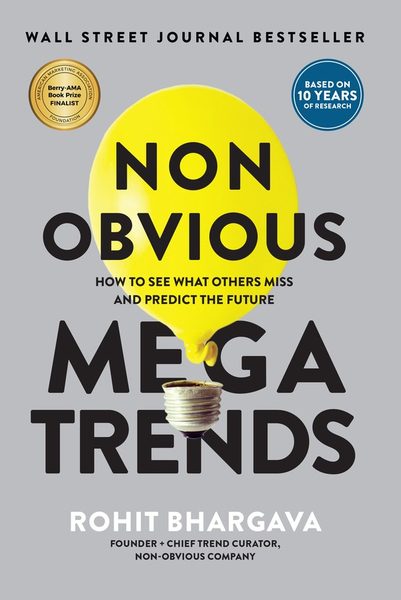
THE BOOK BEHIND THE FRAMEWORK
Non-Obvious Megatrends is the #1 Wall Street Journal bestselling finale of the Non-Obvious Trend Report series, and it takes readers behind the scenes of the Haystack Method.
BRING THE FRAMEWORK TO YOUR STAGE
Rohit teaches the Haystack Method in trend workshops and keynotes for teams who need to see what is coming next before their competitors do.

Want More Non-Obvious Ideas?
The Non-Obvious Insights Newsletter brings you the five or six most fascinating and overlooked stories of the week, with a quick take on why each one matters.
One email every Thursday. No spam, unsubscribe anytime.

Rohit Bhargava is on a mission to inspire more non-obvious thinking in the world.
© 2026 Rohit Bhargava. Washington DC.