
PUBLISHED IN LIKEONOMICS
TRUST = TRUTH + RELEVANCE + UNSELFISHNESS + SIMPLICITY + TIMING
The TRUST model was a framework originally introduced in Likeonomics (published in 2012), where Rohit Bhargava argued that in an era of "modern believability crisis," the organizations and individuals who win are not necessarily the most capable, but the most trusted. The model distills five principles - Truth, Relevance, Unselfishness, Simplicity, and Timing - into a single memorable formula for becoming more believable in any relationship or role.
Since its release, the framework has been widely reviewed, taught, and applied by businesses, marketers, and communicators looking to close what the book calls the "likeability gap" and translate likeability into measurable results.
ABOUT THE FRAMEWORK (FROM THE BOOK)
TRUST = TRUTH + RELEVANCE + UNSELFISHNESS + SIMPLICITY + TIMING
In looking at all the research about how people and organizations become more believable, as well as the impact that social media has had on how we interact with one another and companies, I wanted to uncover some key principles for what really matters when it comes to being more believable. My aim was to find these principles and then create some sort of acronym to describe them. As readers of my blog already know, using acronyms is a method I often use to make new ideas more memorable.
So one day more than a year ago, I gathered all of my research together and started to define what I thought were the most important principles. The starting point was research that had addressed a similar challenge. I looked at Tim Sanders' award-winning work in The Likeability Factor, about how to be more likeable as a person. His four "elements of likeability" came down to friendliness, relevance, empathy, and realness. In his mind, these were in "green light order," which meant you had to be friendly before you could be relevant, and so on. I also looked at the Netherlands Study - a 10-year study on the effects of advertising likeability whose results, published in 2006, proposed that there were four components to advertising likeability: entertainment, relevance, clearness, and pleasantness.
As I sat down one afternoon in February to put some of the research down on paper, five core principles seemed to leap out from all the work I had done. In fact, it was so clear that I assumed they must be wrong or too simple. Since that afternoon in February, I revisited my initial acronym almost every week for months with the intention of changing it.
I did more research, consumed more reports, and read more books. I spoke with colleagues and clients to try and poke holes in the idea. I even presented the acronym during a speech in Miami to get a public reaction and have others criticize it. It still worked.
What was even better, the principles I had landed on spelled a powerful acronym that would fit perfectly into what I wanted to say in the book:
THE FIVE PRINCIPLES OF TRUST
T
There is no truth like the real truth, and we live in a time where people are more able to demand it than ever. This is not, however, the same thing as honesty.
Honesty alone is only the first of three elements of truth:
Three things to remember about truth: Sharing the truth is not the same thing as sharing facts. Truth is something more fundamental and emotional than just a proof point. People respond to human companies in human ways, and sometimes the most human thing you can do is admit an inconvenient truth, like being number two in your industry or having a product that people hate. When you stand up and tell the truth, and then commit to fixing the problem, it inspires not only likeability, but also loyalty and trust.
R
The challenge to be relevant requires that you center yourself on the world that someone else already cares about.
Three things to remember about relevance: Relevance is constantly shifting. The most important thing to remember about relevance is that it is not just about getting people to care about something; it is getting them to care about it right now - so they can eventually be inspired to do something. Without some insight into what the people you want to influence care about, it will be impossible to find a way to be relevant. For that reason, relevance always has to start with some sort of active listening or way to build understanding. The most powerful relevance comes from combining a meaningful point of view and having something to say with the right context for it to really matter to people.
U
If there is one principle that seems dramatically hard to consistently do, it is behaving in an unselfish way.
Three things to remember about unselfishness: Ethical companies that run their business based on ideals consistently have a long-term edge and outperform companies who do not make this a priority. More and more consumers have begun to expect companies to behave in this way, and reward those companies with their loyalty. People have an inherent ability to be altruistic, and this can lead to many positive effects in the world. Beyond compassion, being unselfish also means offering something of value (such as expertise) without expectation of some sort of "karmic kickback."
S
Of all the principles, this one has near universal agreement from leading thinkers in the world about its importance.
Three things to remember about simplicity: Complexity can sometimes be described as a good or necessary thing. Usually, it isn't. When you can simplify an idea or a product or a service, it becomes easier to remember, better to do, and more clear overall. Often, the best simplicity can come from reduction, where you are able to take away any layers or activities that don't matter and focus only on the main core. In professional and personal contexts, the power of visual thinking and drawing pictures instead of just using words can be the perfect way to simplify ideas and make them understood by a wider variety of people.
T
Some of the greatest ideas in human history have succeeded or failed based entirely on timing.
Three things to remember about timing: The best ideas sometimes fail because of bad timing. In this way, timing can be the secret ingredient that explains unexpected success, or unexpected failure. While timing used to be a set variable (you either had it or you didn't), this has changed with today's time-shifting culture. Now, people can shift experiences to have them at times more convenient to them, which has made timing more important than ever. A big part of timing has to do with relating something to the world around it - the same principle at the heart of effective PR efforts when a message relates to stories that are already being written on a topic.
THE BOOK BEHIND THE FRAMEWORK
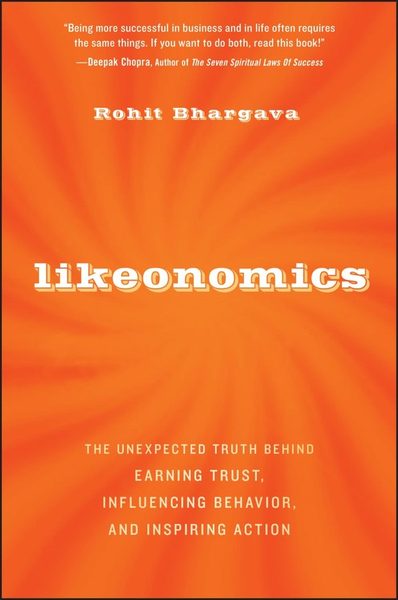
Likeonomics is the book that introduced the TRUST model and made the case that the most believable people and organizations, not the most capable, are the ones who win.
BRING THE FRAMEWORK TO YOUR STAGE
Rohit teaches the TRUST model in keynotes and workshops on trust, believability and marketing that earns attention honestly.

Want More Non-Obvious Ideas?
The Non-Obvious Insights Newsletter brings you the five or six most fascinating and overlooked stories of the week, with a quick take on why each one matters.
One email every Thursday. No spam, unsubscribe anytime.

Rohit Bhargava is on a mission to inspire more non-obvious thinking in the world.
© 2026 Rohit Bhargava. Washington DC.