
PUBLISHED ON THE NON-OBVIOUS BLOG / INFLUENTIAL MARKETING BLOG
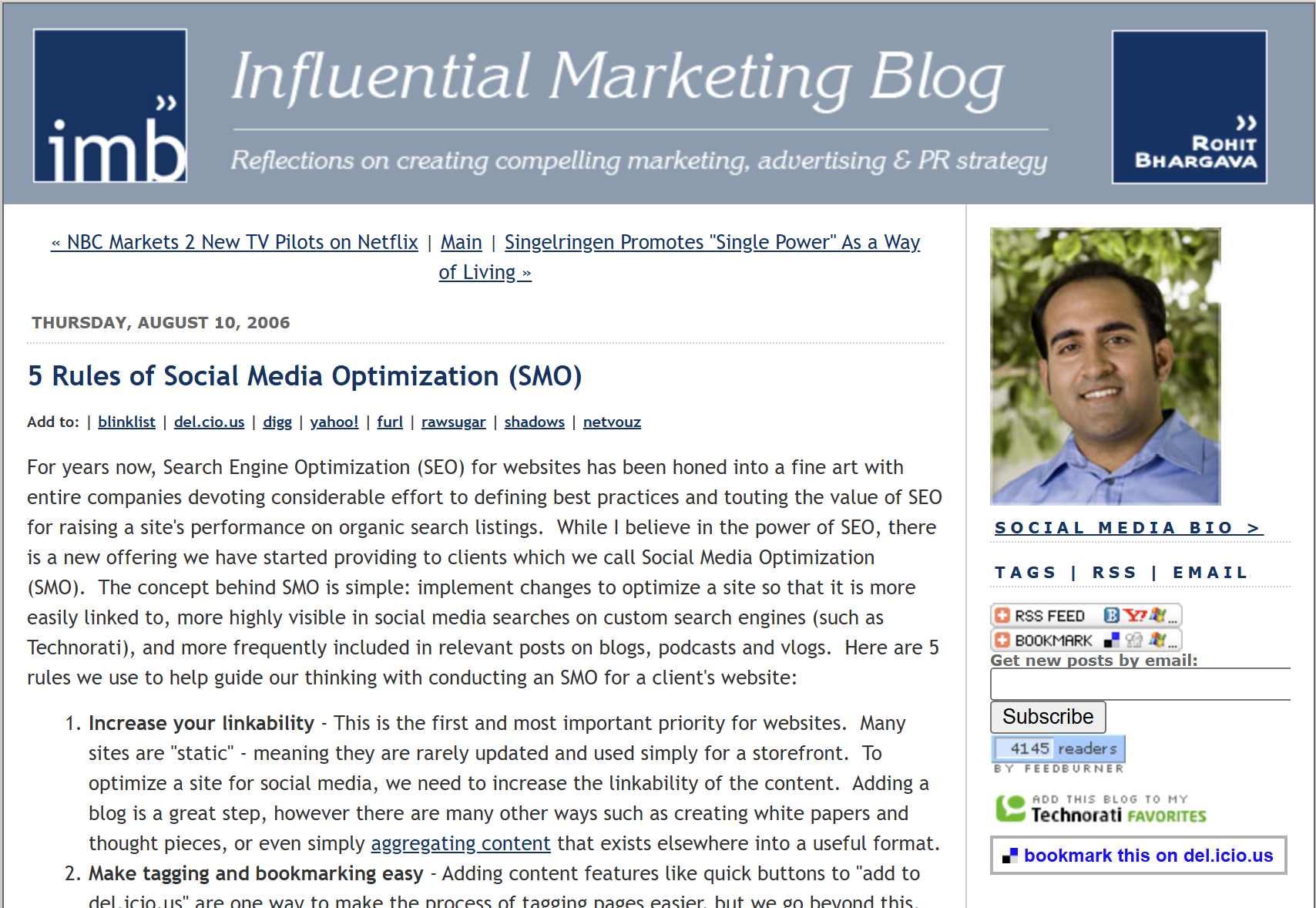
Social Media Optimization is a foundational digital marketing concept first coined and described on Rohit's then-titled Influential Marketing Blog (now rebranded Non-Obvious Insights) in 2006 during the earliest days of social media just a few months after Twitter was first launched and years before Instagram. In his writing, Rohit introduced the five foundational rules of social media optimization in a viral blog post called the "5 Rules of Social Media Optimization (SMO)" published August 10, 2006. That original post has been viewed more than 2 million times and was the foundation for a revolution in digital marketing.
WHERE THE IDEA CAME FROM
The idea was deliberately framed as a counterpart to the already-established practice of search engine optimization. As Rohit wrote at the time, search engine optimization had been honed into a fine art, with entire companies devoting considerable effort to defining best practices for raising a site's performance on organic search listings. SMO proposed a parallel discipline for the emerging world of social media. The concept was simple: implement changes to optimize a site so that it is more easily linked to, more highly visible in social media searches, and more frequently included in relevant posts on blogs, podcasts, and vlogs.
SMO is similar to search engine optimization (SEO) in that the goal is to drive web traffic and draw attention to a company or creator, but SMO's focal point is on gaining organic links to social media content. What happened next demonstrated the very principles the framework described.
Within a week of publication, other influential marketers began building on the original five rules - Jeremiah Owyang added rules 6 and 7, Cameron Olthuis added 8 through 11, Loren Baker added 12 and 13, and Lee Odden added 14 through 16. Altogether an additional 11 SMO rules were ultimately added to the list by other marketing contributors, and the rules were later translated into French, Dutch, Italian, Spanish, German, Japanese, Greek, Portuguese, Russian, Hebrew, and more. The concept was added to Wikipedia within weeks and remains an active entry today. The original post went on to be cited by thousands of blogs and media sources around the world.
Four years later, Rohit published another blog post updating these rules for the new realities of social media, evolving the idea to the "5 NEW Rules of Social Media Optimization." These are the rules that have been adopted by the entire industry.
Nearly two decades later, SMO has now become a permanent part of the digital marketing vocabulary and an established field of both practice and academic study. It is considered an increasingly important factor in search engine optimization, an effective way of implementing online reputation management, and a discipline that extends well beyond marketing.
THE 5 NEW RULES OF SOCIAL MEDIA OPTIMIZATION
Four years after first coining the term, Rohit revisited the framework to answer the question marketers asked him most often: would he change the original five rules given how much the social web had evolved? The short answer was yes. The core change was to add and focus on a word that he felt truly described the social web in a way few people had grasped four years earlier: sharing. These are the five updated rules that resulted.
RULE 1
Formerly: Increase Your Linkability
Four years ago the focus was on linkability because the main currency that could drive up traffic was how many people were linking to your content. Today content can be liked or shared, and it is about more than links - it is about creating content that is shareable. The better your content is, the more people will want to share it with their entire social networks, whether they link it, like it, or share it.
RULE 2
Formerly: Make Tagging & Bookmarking Easy
Tagging and bookmarking only scratch the surface of the many ways people can share content with others. They can post a short link to their profile, embed a video, or create their own content. Limiting the ways of sharing to just tagging or bookmarking doesn't make sense anymore. The core of the original rule, however, was the point about making it easy - and that is still at the heart of this new rule. Once you have shareable content, it has to be one-button-easy so people will do it with minimal effort or thinking.
RULE 3
Formerly: Reward Inbound Links
In 2006, the main thing most marketers were concerned about were inbound links. It was a time when measurement tools were the standard by which we all measured the performance of our content, and many bloggers focused more on their number of inbound links than their readership or traffic numbers. Today the real currency is around conversation or engagement. While there are a million definitions for "engagement" - ranging from comments and discussion to posting or sharing content - this is the behavior that matters most in the social web and the one that we should all focus on rewarding when it happens.
RULE 4
Formerly: Help Your Content Travel
This was the weakest of the original five rules, which simply talked about publishing your content in other formats such as PDFs or videos and submitting them to other sites. The essence of the new version is all about proactively sharing content in a different way. This encompasses everything from creating new forms of content, to expanding the distribution of content across platforms, to offering embeddable versions of it, or using RSS feeds to syndicate it. Proactively sharing even includes posting your content to social networking profiles or creating profiles on video sharing sites.
RULE 5
Unchanged from the original
This is the one original rule Rohit left intact. The concept of the "mashup" - where people take and remix your content by adding their own input and voice - had only grown over the prior four years. The mashup will be around to stay, whether the term continues to be used or not. Allowing people to take ownership over the social content you publish will continue to be a key way that you can optimize your content for the social web.

GO DEEPER ON MARKETING
Two decades after coining SMO, Rohit put the rest of what he has learned about earning attention into a practical guide for marketers and founders.
BRING THE FRAMEWORK TO YOUR STAGE
Rohit's marketing keynote reveals what actually works to command attention, build loyalty and generate real results.

Want More Non-Obvious Ideas?
The Non-Obvious Insights Newsletter brings you the five or six most fascinating and overlooked stories of the week, with a quick take on why each one matters.
One email every Thursday. No spam, unsubscribe anytime.

Rohit Bhargava is on a mission to inspire more non-obvious thinking in the world.
© 2026 Rohit Bhargava. Washington DC.