
PUBLISHED IN THE FUTURE NORMAL
The Future Normal is a handbook for visionaries, presenting the 30 biggest non-obvious ideas and instigators expected to shape humanity's next decade. Its credibility comes from the unusual pairing behind it: for the past decade, Rohit Bhargava and Henry Coutinho-Mason have been on the front lines of the future, independently leading two of the most successful trend consultancies in the world - the Non-Obvious Company and TrendWatching.
The book's premise is that making outlandish predictions about the future is easy; predicting the future normal - the ideas that will quietly become an accepted part of everyday life - is far harder. Rather than relying on speculation, the authors' research took them into cutting-edge labs, private testing facilities, and invite-only showcases around the world, from donning full-body haptic suits to sampling cultivated meat.
Grounded in an "equilibrium of optimism and reality," the book organizes its 30 trends into three forward-looking parts and pairs each with real-world instigators already bringing it to life. Widely praised by thinkers including Daniel Pink and the founding editor of WIRED UK, The Future Normal has been recognized with numerous book awards, and this updated second edition expands the analysis to tackle the ethical and societal questions raised by the rapid rise of AI.
PART 1
TREND 01
What if we could all be our real and most authentic selves both online and offline? As virtual and physical worlds blend, people are increasingly able to show up across many forms - and the trend points toward a future where being your imperfect, authentic self is finally safer and more celebrated everywhere.
TREND 02
What if you could be part of entertainment instead of watching it passively? In the future normal, describing these experiences as merely entertainment will feel inadequate, as immersive moments gain the power to shape the reality around us and let us forget the outside world even exists.
TREND 03
What if you could trust the authenticity of the media and content you consume? As synthetic content and deepfakes explode, new tools and standards will emerge to verify what is real, making the ability to certify the origin of media essential to rebuilding trust.
TREND 04
What if you could educate yourself using the very videos and games that are typically written off as a waste of time? In the future normal, stealth learning can make education seamless and enjoyable for all ages by hiding it inside the content and games people already love.
TREND 05
What if closing the generation gap could cure loneliness at any age? In the future normal, more people of different generations will find comfort in connecting with one another, often through government-sponsored initiatives or private co-living spaces designed to bring them together.
TREND 06
What if you could develop a meaningful relationship with an app or a robot? In the future normal, a growing range of chatbots, virtual companions, and human-designed virtual influencers will provide meaningful, empathetic emotional support and even friendship, becoming beloved additions to our lives.
TREND 07
What if mainstream medicine tuned into the mental health benefits of psychedelics? In the future normal, the growing challenges of mental health and the ongoing costs of treatment will lead more people and healthcare professionals to consider psychedelic treatments as a better alternative care option for some patients.
TREND 08
What if buildings and homes protected - and even boosted - our health and well-being? In the future normal, we'll demand that the spaces we live in provide not just basic shelter and functionality, but features that actively boost our health, well-being, and even our performance.
TREND 09
What if doctors prescribed nature like they prescribe drugs? As the benefits of nature in combating mental and physical afflictions become better proven, it will be increasingly common for doctors, patients, governments, and insurance companies to embrace "green prescriptions."
TREND 10
What if tracking your glucose level became as normal as counting your steps? As continuous glucose monitors move from diabetics to health-conscious consumers - and AI begins predicting glucose responses before a meal - real-time metabolic data will become a mainstream tool for managing everyday health.
PART 2
TREND 11
What if artificial intelligence could make humans more creative? In the future normal, people will remember the sense of magic they felt the first time generative AI tools like DALL-E 2 or ChatGPT let them create an image or a passage of text in seconds, as AI becomes a partner that amplifies human creativity.
TREND 12
What if even the most physical of jobs - from tattooists to truck drivers - could be done remotely? As teleoperated robots and remote-controlled services mature, even hands-on physical work will increasingly be performed from anywhere, opening up an entirely new remote workforce.
TREND 13
What if work flexibility meant sharing your job equally with a partner? In the future normal, the organizations willing to rethink their longest-held assumptions about work - and embrace new arrangements such as job sharing - will be the ones who attract and retain the best talent.
TREND 14
What if our organizations' cultures reflected the societies in which they operate? In the future normal, it will be impossible for any organization to claim it supports meaningful diversity and inclusion by pointing to small product tweaks or ad campaigns alone, as authentic, top-to-bottom cultural reflection becomes the expectation.
TREND 15
What if more of the world's biggest businesses prioritized doing good over profits? As movements like B Corp expand and AI makes it harder than ever to hide corporate hypocrisy, the world's largest companies will face growing pressure to redeem themselves by genuinely putting purpose ahead of profit.
TREND 16
What if your office space could contribute to the local economy and community? As work decentralizes, community-centric workspaces will increasingly double as engines of local economic and social impact, turning surplus space into a shared community asset.
TREND 17
What if "fake" was better? In the future normal, companies will increasingly make synthetic alternatives to today's products that are even better - higher performance, more ethically produced, and more sustainable - than their natural competitors.
TREND 18
What if we started tracking our carbon footprints in the same way we track our calorie or salt intakes? In the future normal, more companies will be transparent about the carbon emissions of their products, making simple calculations of the impact of our consumption choices as easy as counting calories.
TREND 19
What if you didn't have to give up products and experiences that are not great for you or the planet? As technology scales up ethical and sustainable alternatives, people will increasingly be able to enjoy the products and experiences they love without the guilt that usually comes with them.
TREND 20
What if buying pre-loved goods became a sign of savviness and source of pride? Resale is becoming wholly unremarkable across low and high ends alike, and as technology boosts confidence in buying used items, choosing secondhand will increasingly signal savviness rather than sacrifice.
PART 3
TREND 21
What if startup founders dreamed of more than venture capital and unicorns? In the future normal, "community exits" and other collective models of ownership will become increasingly common and easy to form, offering founders an alternative to the venture-capital-and-unicorn playbook.
TREND 22
What if government policies were recognized for actually making citizens' lives better? In the future normal there will still be lying politicians and self-serving legislators, but there will also be a growing movement to spotlight and replicate the policies that genuinely improve citizens' lives.
TREND 23
What if every long journey in the city was cut to 15 minutes? As cities rethink urban design around proximity rather than commuting, the goal of placing daily needs within a short walk or ride will reshape how neighborhoods are planned - balancing algorithmic optimization with human-centered design.
TREND 24
What if you could get anything delivered to your doorstep within minutes? In the future normal, continued developments in the safety and capability of drones and autonomous vehicles will provide rural customers, suburban families, and even those needing emergency medical supplies with faster and more reliable delivery.
TREND 25
What if we invested in more green infrastructure to make cities more sustainable? In the future normal, we won't rely solely on air-conditioning to make our cities livable, but will instead invest in trees and green infrastructure that cool, clean, and sustain urban life.
TREND 26
What if we could make clean, abundant food for everyone out of thin air? As science fiction becomes science fact, a wave of foodtech startups - producing protein from air, data, and AI-driven farming - will fundamentally change the way we make and eat food.
TREND 27
What if you could throw things away with a clean conscience? As innovations like AI-engineered enzymes and plastic-eating organisms advance, products will increasingly be designed to be waste-free from the start, breaking down harmlessly rather than lingering for centuries.
TREND 28
What if you could generate your own energy - reliably and cheaply? In the future normal, the notion of centralized energy systems may feel as alien as landline telephones, as distributed microgrids and virtual power plants let homes and communities generate their own reliable, affordable power.
TREND 29
What if humanity could control the weather to fight the effects of global warming? In the future normal, more scientists and innovators will study how to wield control of the weather incrementally and responsibly to decrease the impact of global warming.
TREND 30
What if companies aimed beyond going carbon neutral and toward being actively regenerative? In the future normal, we will see an acceleration in brands that go carbon negative, regenerate the environment, and leave a positive legacy on the planet.
HOW TO USE THESE TRENDS
Each trend in the book comes with the questions worth arguing about in your own organization. Use them to turn a trend into a decision.
1. MULTIVERSAL IDENTITY
2. IMMERSIVE ENTERTAINMENT
3. CERTIFIED MEDIA
4. STEALTH LEARNING
5. ENDING LONELINESS
6. VIRTUAL COMPANIONSHIP
7. PSYCHEDELIC WELLNESS
8. AMBIENT HEALTH
9. GREEN PRESCRIPTIONS
10. METABOLIC MONITORING
11. AUGMENTED CREATIVITY
12. REMOTE WORK FOR ALL
13. WORK DECONSTRUCTED
14. REFLECTIVE CULTURES
15. BIG BRAND REDEMPTION
16. IMPACT HUBS
17. UNNATURALLY BETTER
18. CALCULATED CONSUMPTION
19. GUILT-FREE INDULGENCE
20. SECONDHAND STATUS
21. NEW COLLECTIVISM
22. GOOD GOVERNING
23. THE 15-MINUTE CITY
24. INHUMAN DELIVERY
25. URBAN FORESTS
26. NU-AGRICULTURE
27. WASTE-FREE PRODUCTS
28. MILLIONS OF MICROGRIDS
29. MAKING WEATHER
30. BEYOND NET ZERO
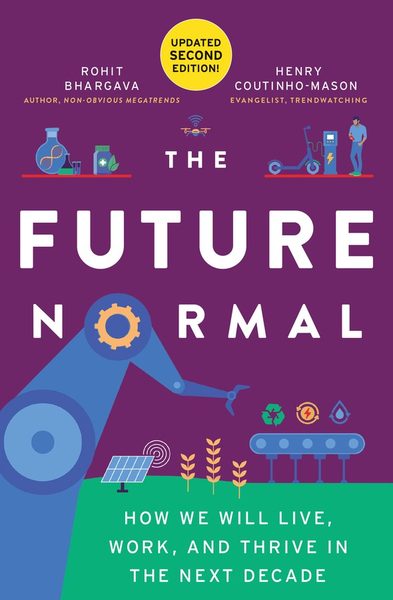
THE BOOK BEHIND THE TRENDS
The Future Normal, by Rohit Bhargava and Henry Coutinho-Mason, tells the full story of all 30 trends and profiles the instigators already making them real.
BRING THE TRENDS TO YOUR STAGE
Rohit's signature futurism keynote is a fast-paced, deeply optimistic look at the ideas and instigators already shaping the next decade.
Want More Non-Obvious Ideas?
The Non-Obvious Insights Newsletter brings you the five or six most fascinating and overlooked stories of the week, with a quick take on why each one matters.
One email every Thursday. No spam, unsubscribe anytime.

Rohit Bhargava is on a mission to inspire more non-obvious thinking in the world.
© 2026 Rohit Bhargava. Washington DC.