








AUGUST 7, 2007|TECHNOLOGY & SOFTWARE
How To Find Sites Faster Online Without Using Google
Google is great when you are searching for a single webpage or source of information. Many of my searches still fit that category - so I'm a big Google user. The problem is, more and more often I find myself searching not for a single page, but for a web site. A lot of times that may be a new website or a popular website that many people have found useful. When it comes to a search like this, Google is not so helpful. Here are a few reasons Google doesn't work so well in these situations:
- Newer websites seldom appear highly because they have not been out long enough to get ranked and assessed in Google's algorithm
- The most useful content is sometimes not optimized and therefore appears too low in results to ever be found
- Crawler brings back any page, and not just the homepage of sites, not useful if you want to find a site instead of a page
- There is no popularity index to see what sites or pages people recently found useful (pagerank is based on links and clicks)
- Using keywords and algorithms is sometimes not as powerful as using tags and keywords other people have assigned to content online
Instead, I use . Rather than using an algorithm, you can use del.icio.us to "search" using the tags that people have assigned to links. Each link has a rating based on the number of others who have also saved that link. The difference is, you are finding sites instead of individual web pages. For an example of the difference, here's an experience I recently had when seeking new online food communities to check out:
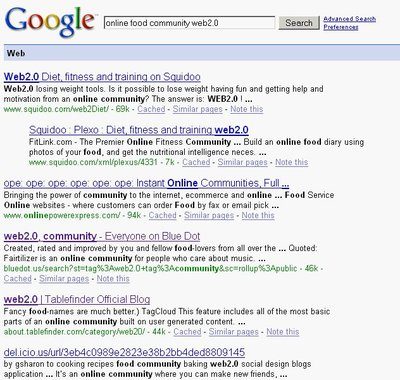
Google search for "online food community web2.0"
(Useful sites returned in first page: Tablefinder - if only I could read Swedish)
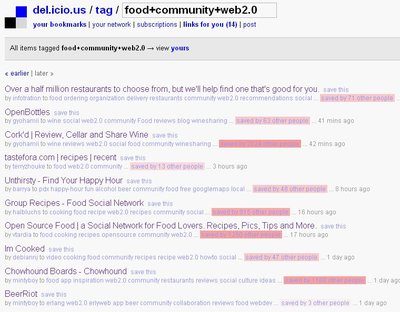
del.icio.us tag search for ""
(Useful sites returned in first page: foodio54, OpenBottles, Cork'd, Tastefora, GroupRecipies, OpenSourceFood, Imcooked, Chowhounds, TheDailyPlate)
Just this week I have already used del.icio.us to find usage statistics for women online, popular new online food and cooking communities (example above), and a list of green blogs. Each search was much faster on del.icio.us and yielded useful results much more easily. This is the power of using tagging and social bookmarking to find information online. It is also the reason why the next time you seek information online you might want to start on a site like del.icio.us instead of with Google.
Related Posts
Book Rohit To Speak
Want to bring these ideas to your next event?
Rohit turns the thinking behind posts like this one into keynotes for audiences around the world, from Fortune 500 leadership teams to global industry conferences.
Learn More About Speaking
How It All Started
A Short Backstory Of This Blog
This is a blog about non-obvious ideas. Originally launched on the Typepad platform in 2005 as the Influential Marketing blog, the stories at first focused mainly on digital marketing while Rohit worked at Ogilvy Advertising. In 2015 Rohit officially rebranded to the Non-Obvious Insights Blog and published his WSJ bestseller Non-Obvious. For the past twenty one years, this blog has coined new terms, introduced future marketing practices and inspired the next generation of non-obvious thinkers and marketers.